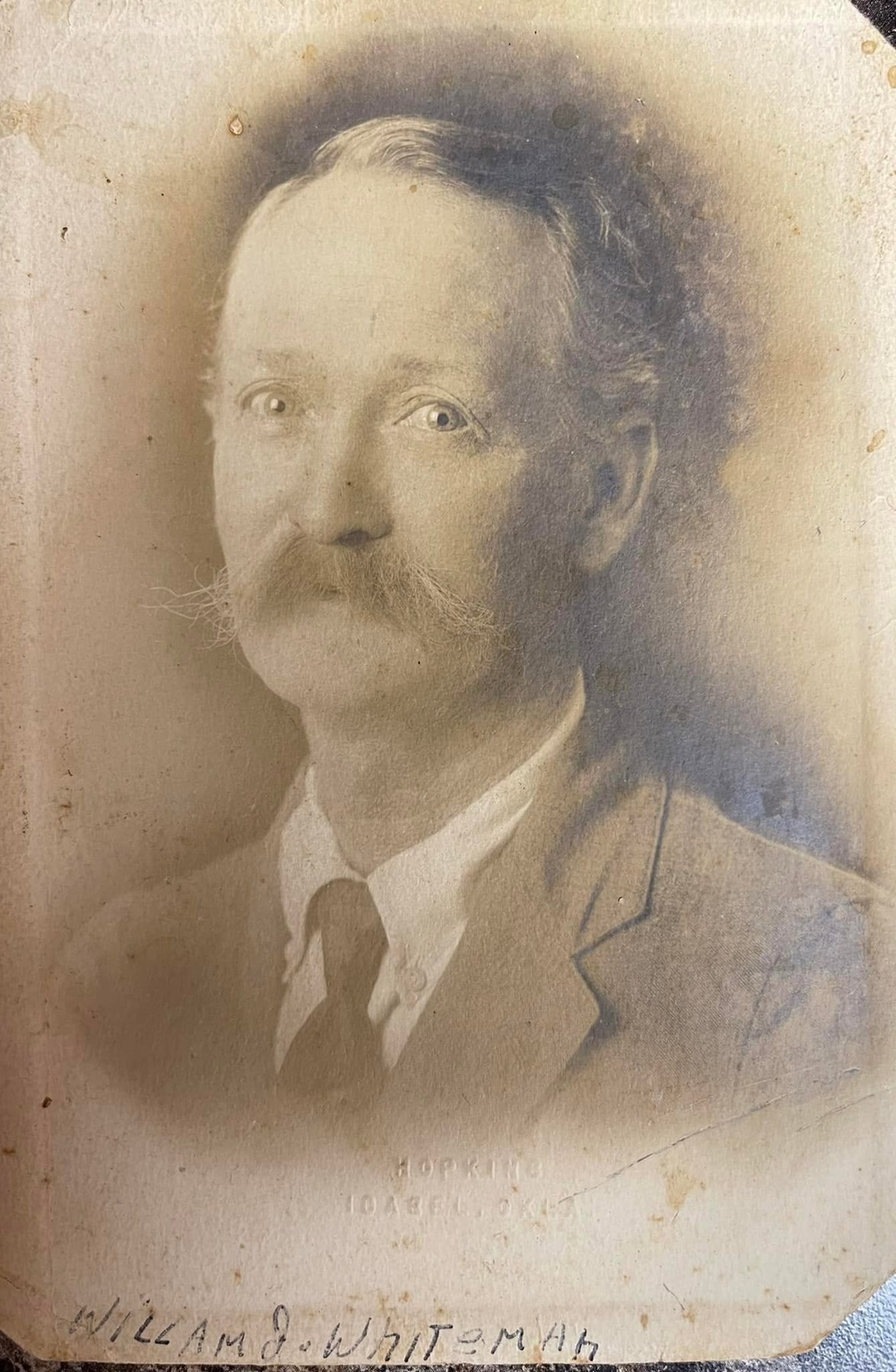
One home, three communities
W. J. Whiteman's documented life radiated outward from Goodwater. Contemporary records repeatedly identify him as being “of Goodwater” while recording banking, commercial, civic, agricultural and legal activity in Haworth and Idabel. The surviving family home is therefore not simply an old residence; it is the physical anchor of a life tied to the territorial and early-statehood development of McCurtain County.
From Red River County to Indian Territory
Later biographical sources place Whiteman's origins in Red River County, Texas and his settlement at Goodwater in 1893. Family history holds that the Goodwater house was built in 1893 as a wedding gift connected to Mattie J. Harris and her parents, including Choctaw jurist Henry C. Harris. The exact wedding-gift history remains a family-established account while deeds, Harris papers and other contemporary records are being sought.
Goodwater before Oklahoma statehood
Federal postal records document W. J. Whiteman's appointment as Goodwater postmaster in December 1894. The 1902–03 Polk directory described Goodwater as a Choctaw Nation country post office and listed “WHITEMAN W J” as a stock breeder and notary public. The same directory separately listed H. R. Whiteman as a cotton-gin operator and the Goodwater Mercantile & Investment Co. as dealing in general merchandise, real estate and lumber. These entries show a developing commercial community, but they do not by themselves prove W.J. founded every Goodwater company.
Read the 1902–03 directory transcription.
Statehood and county civic life
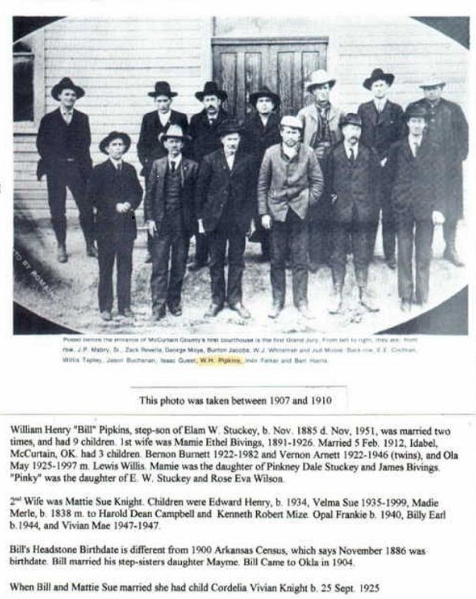
A surviving historical reproduction identifies W.J. among men associated with McCurtain County's first-grand-jury era. The Whiteman family identifies him as the front-row man second from right. A later biography also states that he served on the county's first grand jury. Because the original empanelment order has not yet been recovered, the precise jury term and date remain under investigation.
Other civic evidence is firmer. In 1916 a countywide organization of school boards elected W.J. president; contemporary reporting said at least forty school-district officers participated. In 1924 the Idabel Lions Club charter roster listed him as a farmer.
1916 school-board organization · 1924 Lions roster
Haworth: banking, cotton and infrastructure
By 1911 Whiteman was first vice president and a director of the Bank of Haworth. The same contemporary Haworth page advertised his Murray Improved Gin west of the depot and south of the railroad track, equipped with three 70-saw stands, and reported that W.T. Wilcoxin and W.J. Whiteman had received a franchise for Haworth waterworks with work already begun. In 1914 W.J. was documented as president of First National Bank of Haworth and as a director of the Herald Publishing Company. A 1923 bankers directory still associates W.J. Whiteman with First National Bank at Haworth.
1911 Haworth bank and gin · 1911 waterworks account · 1923 bankers directory
Idabel and a long banking connection
W.J. appears as a director of First National Bank of Idabel in 1911, 1922 and 1923 records. The March 1922 bank statement is especially useful because it names C.A. Denison as president while listing W.J. among the directors. That evidence requires caution with a 1924 Congressional speech that described “Jordan Whiteman” as president of the First National Bank at Idabel. The speech is important evidence of how he was described in Congress, but the bank's own 1922 advertisement shows that his precise Idabel title must not be assumed.
1911 Idabel bank · 1922 Idabel bank statement · 1923 Idabel bank directors
Agriculture as a continuous career
The territorial directory's “stock breeder” description was not a passing label. In 1917 the Haworth Herald reported that W.J. brought Hereford calves from Wisconsin and distributed most of them among Goodwater-area farmers, with plans for another shipment. In January 1920 the McCurtain Gazette reported his retirement from mercantile stores at Goodwater, Jadie and Haworth while noting several thousand acres of farming land and his continuing banking interests. Four years later the Lions roster simply identified his occupation as “Farmer.”
Land development: two Whiteman Additions
Whiteman Addition to Haworth is independently documented by 1917, and contemporary property material places W.J. himself among property holders within the addition. In Idabel, Whiteman Addition was established by 1919 and was large enough to be incorporated into municipal sewer planning, with numbered blocks extending through at least Block 28. The 1936 National Guard Armory was later built on Lots 1–4, Block 7 of Whiteman Addition in Idabel. Family and local history identify both additions as named for W.J.; the original recorded plats remain sought to establish filing dates, proprietors, parent tracts and signatures.
1919 Idabel Whiteman Addition · 1936 armory documentation
Land, guardianships and Choctaw allotments
W.J.'s legal record is complex and should not be reduced either to celebration or accusation. Court and newspaper records document him as a guardian, petitioner and record claimant in matters involving Choctaw citizens and allotted lands. In 1922 he personally petitioned for judicial determination of the heirs of Dixon McClure and Michael Williams. Other 1922 proceedings list W.J., William Spencer, Fred Ptak, Red River Petroleum Company and others as record claimants in Moore, Coxwell and Wilson heirship cases. One particularly important proceeding, Probate No. 2666, concerns Louie Coxwell, who had earlier been among minors placed under W.J.'s guardianship. The instruments that created W.J.'s later property interests have not yet been recovered, so motive or propriety should not be inferred from the claimant notices alone.
1922 heirship notices · Dixon McClure and Michael Williams proceedings
The Ledcie Stechi case and national scrutiny
The most difficult part of W.J.'s documented history concerns Ledcie Stechi, a Choctaw child whose valuable inherited oil interests were administered under guardianship. A 1924 Indian-rights report made severe allegations about Ledcie's treatment while W.J. was guardian. Congressional debate that year repeated the controversy and also entered a letter from McCurtain County Judge Thomas G. Carr presenting a defense and additional chronology. Later court decisions independently confirm the underlying Stechi estate involved valuable Carter County oil-and-gas interests. These sources disagree sharply about responsibility and conduct; this project presents the allegations, responses and legal record as distinct evidence rather than turning any one account into an uncontested verdict.
1924 Congressional Record · 1930 Stechi v. Lee
The home remained the anchor
Across this expanding record, newspapers repeatedly continued to identify him with Goodwater. In 1913 a paper reported that “W J Whiteman came up from Goodwater.” In 1914, while he was a director of a Haworth publishing company, the Haworth Herald still called him “W J Whiteman of Goodwater.” In 1921 the Gazette used the name “Jordan Whiteman, of Goodwater.” That continuity is central to the preservation story: the surviving house represents the place to which his public identity remained attached while his activities extended across the county.
What remains unresolved
The research continues on the original grand-jury roster; the two Whiteman Addition plats; the 1918 5,000-acre land offering involving W.J., William Spencer, H.C. Morris and C.P. Baker; the Moore/Coxwell deed and mineral chain; the complete Ledcie Stechi guardianship file; the original Harris-family records behind the 1893 wedding-gift tradition; and the conflicting evidence concerning W.J.'s birth year. Those unresolved questions are identified rather than quietly filled with guesses.